
Last updated: March 2026
When a patient asks me what the operation involves, I draw an orange. Men are born with the peel — the prostatic capsule — and from the age of 30, the segments inside gradually grow. Since the urethra runs through the centre, it becomes progressively obstructed. What we do in an enucleation is remove the segments and leave the peel clean.
But how those segments are removed matters a great deal. Cutting them into pieces is not the same as peeling them out in one go. En bloc enucleation with early apical release is the technique I have developed and refined over two decades and more than 10,000 procedures. In this article, I explain what makes it different and why I believe it delivers better outcomes.
What does "en bloc" mean in prostate surgery?
In conventional holmium laser enucleation (HoLEP), the prostatic adenoma is typically divided into two or three lobes. Deep incisions are made to separate the lobes, and each fragment is then dissected from the capsule individually. It is a technique that works, but it involves multiple cuts through tissue and working with several separate pieces.
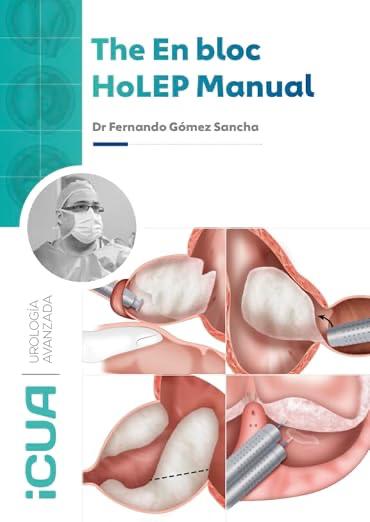
In en bloc enucleation, the adenoma is removed in a single piece — like peeling an entire orange, keeping all the segments attached. There are no incisions to fragment the adenoma. The surgeon peels the entire piece circumferentially from the capsule until it is freed as a whole into the bladder, where it is morcellated for extraction.
The advantages of this approach are several: less bleeding because the large vessels between the lobes are not transected, better tissue orientation for the pathologist (important if incidental cancer is found), and — most critically — more precise control of the urinary sphincter, the structure responsible for continence.
The evolution: from vaporisation to en bloc
This technique did not appear overnight. It was the result of an evolution that began over 20 years ago.
My beginnings in laser surgery were with GreenLight laser vaporisation in 2003. We quickly recognised the advantages of the endoscopic approach — minimal invasiveness, rapid recovery, low complication rates — but also understood the limits of vaporisation in large prostates.
The evolution was gradual: conventional vaporisation → anatomical vaporisation (identifying the capsule to take the vaporisation to that depth) → hybrid technique of lateral vaporisation with middle lobe enucleation → progressively less vaporisation and more enucleation → complete en bloc enucleation with GreenLight laser (GreenLEP). We published this evolution in 2015 (Gómez Sancha et al., World J Urol).
In 2011, I began working with the holmium laser. I initially learned the three-lobe technique, but quickly sought to reproduce the en bloc approach I had been performing for several years with the green laser. This led to the publication of our technique in 2019 (Saitta, Gómez Sancha et al., World J Urol): an incision-free en bloc enucleation with early apical release and sphincteric mucosa preservation, initially in 137 patients.
Early apical release: why it makes the difference
This is the core of what differentiates this technique from other enucleation methods. To understand why it matters, a brief lesson in anatomy is needed.
The external sphincter and its mucosa
The external urinary sphincter is the muscle that maintains continence — the one that allows a man to control when he urinates and when he does not. This sphincter is lined by a mucosa, a layer of tissue that functions as a watertight seal. Without this mucosa intact, the sphincter can be incontinent for weeks or months until the mucosa regenerates.
In many enucleation techniques, the apical dissection (the lowest part of the adenoma, just above the sphincter) is left until the end. The problem is that as the adenoma is peeled from above downwards, traction is generated on the sphincter. This traction strips the sphincteric mucosa, creating what is known as the "mucosal curtain" — a flap of tissue that indicates the sphincter's lining has been damaged.
What makes early apical release different
In our technique, the first step is to identify the "white line" — the boundary between the adenoma apex and the external sphincter. At that point, we release the adenoma from the sphincter at the beginning of the procedure, not at the end. By separating the adenoma from the sphincter early, we achieve three things:
- We eliminate traction: when dissecting the rest of the adenoma circumferentially, we are no longer pulling on the sphincter because it has already been freed.
- We preserve the sphincteric mucosa: without traction, the mucosa lining the sphincter remains intact, maintaining its sealing function.
- We improve visibility: with the apex released from the outset, the surgical field throughout the remainder of the procedure is excellent.

No incisions: another key principle
Many enucleation techniques begin with deep incisions into the adenoma — at the 5 and 7 o'clock positions, or at 12 o'clock — to separate the lobes. These incisions transect vessels and cause bleeding, and divide the adenoma into fragments that must then be dissected separately.
In the en bloc technique, there are no initial incisions. The dissection is circumferential, peeling the adenoma from the capsule like peeling a fruit. The laser is used to coagulate feeding vessels (the pedicles) and to cut fibrous tracts when necessary, but the bulk of the separation is mechanical, with the tip of the endoscope.
The result is an adenoma removed in a single piece, with less bleeding and — crucially — perfectly orientable for the pathologist. If incidental cancer is present (which occurs in 5–8% of cases), the pathologist can assess the margins with the same precision as a conventional surgical specimen.
Published results
Our most recent series, published in World Journal of Urology in 2025, includes 754 consecutive patients operated by a single surgeon using this technique:
Efficiency: 3.1 g/min in large prostates (≥120 g) · Mean operative time 47 min (initial 137-patient series)
Continence (stress incontinence at 6 months): 0.15% for prostates <120 0.9="" br="" for="" g="" prostates="">
Functional outcomes: Qmax 24–28 ml/s postoperatively · PSA reduction 93–94%
Safety: Transfusion rate <1 div="" rate="" retreatment="">
To put the continence figure in context: a stress incontinence rate of 0.15% at six months means that of every 1,000 patients operated with prostates under 120 grams, only 1 or 2 would need a pad for stress incontinence at six months after surgery.
The REAP registry, a global multicentre registry of 6,193 patients operated by multiple surgeons using enucleation techniques with early apical release, confirmed that the principle of early apex release is associated with low incontinence rates even when performed by different surgeons at different centres.
Reproducibility: a technique taught worldwide
Any surgical technique, however good, has limited value if only one person can perform it. That is why reproducibility is a fundamental criterion.
Since 2007, we have received over 600 visiting urologists from more than 60 countries at ICUA to train in this technique. The training programme includes direct operating theatre observation, tutored practice, and subsequent follow-up. Many of these surgeons have implemented the technique at their own centres with published results.
In a published series of 500 patients with learning curve analysis (Wenk et al., 2024), it was demonstrated that the en bloc technique is reproducible and that the learning curve, when training is structured, is shorter than traditionally attributed to HoLEP.
It is not an easy technique — it requires specific training and sufficient case volume. But it is teachable and reproducible, and that is what matters.
For the patient: what does all this mean for you?
If you have read this far, you are probably an informed patient who researches before making a decision, or a urologist evaluating technical options. Either way, the key point is this:
Not all HoLEP procedures are the same. The surgical technique, the principles guiding the operation, and the surgeon's experience determine the outcomes in continence, complications, and the likelihood of needing reoperation. En bloc enucleation with early apical release and sphincteric mucosa preservation is the product of over 20 years of technical evolution, more than 10,000 cases, and a clear philosophy: remove the entire adenoma while maximally protecting the structures of continence.
At ICUA we perform this surgery daily. Request a consultation to evaluate your case.
📞 +34 91 435 28 44 · ✉ icua@icua.es
Scientific references
- Saitta G, Becerra JEA, Del Álamo JF, Gómez Sancha F, et al. 'En Bloc' HoLEP with early apical release in benign prostatic hyperplasia. World J Urol. 2019;37:2451-2458. PubMed
- Iscaife A, Rodríguez Socarrás M, Talizin TB, Gómez Sancha F, et al. Contemporary results of En Bloc HoLEP for large prostates — a single surgeon series of 754 patients. World J Urol. 2025;43:401. PubMed
- Gómez Sancha F, Rodríguez Socarrás M, Zorn K, et al. Common trend: move to enucleation — is there a case for GreenLEP? World J Urol. 2015;33:539-547. DOI
- Gauhar V, Gómez Sancha F, Enikeev D, et al. Results from a global multicenter registry of 6193 patients (REAP). World J Urol. 2023;41:3033-3040. PubMed
- Wenk B, et al. En bloc HoLEP learning curve in 500 consecutive patients. World J Urol. 2024. PubMed
- Gauhar V, et al. Early apical release during endoscopic enucleation of the prostate (EAR) — 4392 patients. Urology. 2024. DOI


No comments:
Post a Comment