Sunday, June 28, 2026

How a Patient-Preference Survey Decides Its Own Answer

A methodological reading of a sponsor-funded BPH survey — and what the independent literature finds when it asks the harder question.

A 2020 survey of men facing or recovering from BPH surgery asked them, in writing, whether they would be willing to sacrifice sexual function for relief of their urinary symptoms. The question sits in the published instrument as item Q14 for men still considering surgery and as Q10S for men who had already had it. The paper that reported the survey never tells you how they answered. It reports instead that 95% of respondents considered maintaining erectile function important and 92% considered maintaining ejaculatory function important, and it builds its conclusion on those two numbers. The willingness-to-trade item was asked and dropped.

It is not a small omission, and the reason it is not small is the whole point.

A survey can choose its answer before anyone responds

When you ask a man whether maintaining erectile function matters to him, and you ask it on its own, you have not learned much. Endorsing a desirable thing in isolation costs the respondent nothing. There is no competing good on the table, no price to pay for saying yes. Under that format, near-universal agreement is the expected result for almost any attribute a person would, all else equal, prefer to keep. Ninety-five percent is not a finding about how much sexual function weighs in a surgical decision. It is a property of the question.

The way to learn what an attribute actually weighs is to make the respondent give something up to get it. A conjoint or discrete-choice design does this directly: it presents competing treatment profiles and forces a choice between them, so that valuing one attribute more means accepting less of another. The number that comes out is a relative weight, not an endorsement. The same man who says, in isolation, that ejaculation matters to him will, when made to choose between a treatment that preserves it and one that relieves his symptoms faster or carries less risk of a serious complication, often choose the second. Both answers are his. They are not in tension. They measure different things.

The headline a preference study produces is governed by whether it forces a trade-off. This survey used the format that inflates, and declined to report the format that would have deflated.

What the instrument contains

The two figures the paper leads with come from Q10 and Q11. Q10 asks, on a five-point importance scale, how important maintaining erectile function after surgery is. Q11 asks, on the same scale, how important it is to also maintain the ability to ejaculate normally — under an explicit instruction to assume erectile function has already been preserved. The conditional framing is not neutral. Having been granted one preserved function, the respondent is invited to add a second at no cost, and the word also does the work. Neither item asks him to weigh sexual function against anything.

The instrument was capable of asking him to. Item Q9, for men considering surgery, asks what the most important considerations are when choosing a type of BPH surgery and instructs the respondent to select up to two. The options are time under anaesthesia, hospital stay, risk of side effects, recovery, and having a catheter. Sexual function is not among them. The one question in the survey that forces a ranking of priorities does not offer the attribute the paper is built around. Its retrospective twin, Q3S, has the same structure and the same omission. Neither question’s results appear in the paper.

The survey also asked the trade-off outright. Q14 and Q10S put the proposition in a single sentence — willing to sacrifice sexual function for symptom relief, agree or disagree — and Q9S asks the respondent to agree or disagree that every surgical option seemed to require a trade-off between symptom relief and side effects. These are the items that would have told us what sexual function weighs against the thing men actually present for. None of their results are reported. The complete published record consists of the article body and a single supplementary file, the questionnaire itself; the answers to Q14, Q10S, Q9S, Q9 and Q3S are in neither.

The discussion’s claim that men “did not realize how important” sexual function was to them — the basis for the paper’s regret narrative — rests on item Q17S, two statements the respondent is asked to endorse: that before surgery he did not realize how important maintaining sexual, and then ejaculatory, function was. The statements presuppose the importance and measure only whether he will say he failed to appreciate it. There is no counterbalancing item, none asking whether he worried about sexual function more than the outcome warranted. An instrument that offers only one direction of agreement manufactures the conclusion it then reports.

One device appears in the instrument by name in a question of its own. Q20, shown to both groups, asks whether the respondent’s urologist discussed Aquablation therapy with him. There is no equivalent item for UroLift, for Rezum, or for any enucleation technique. A question measuring the discussion penetration of a single named product is market research; its presence in a patient-perspectives survey, in a study whose sample contains exactly one Aquablation patient, tells you what the instrument was partly built to find out.

What men choose when they have to choose

The independent literature that uses the harder design reaches the opposite headline. In a conjoint analysis of 812 men, forcing a choice between treatment profiles defined by efficacy, recovery difficulty, complication risk, and de novo ejaculatory dysfunction, the risk of a serious complication was the most heavily weighted attribute and ejaculatory dysfunction was the least. That sample skewed younger and milder than a surgical population — a group that should, if anything, weight sexual function more heavily rather than less — and ejaculation still came last.

The same study put the older question to its own participants as well. Asked to rate, in isolation, how important maintaining ejaculation was to them, the men scored it four out of five, and then, forced to choose, placed it last. The divergence is not an artefact of comparing one population with another. It appears within a single cohort, turning only on whether the question made them trade. And the authors of that study say as much about the survey discussed here: its finding that sexual function mattered to nearly everyone regardless of age came, they note, from a design that never required participants to rank one attribute against another.

A 2026 multicentre study of 622 surgical candidates and 82 surgeons, using validated symptom and erectile-function instruments and asking both groups to rank their priorities, found continence ranked first by patients and surgeons alike. Ejaculation was ranked low overall, though a minority of patients placed it high. These were not men indifferent to sex: the study excluded sexually inactive patients, so its sample was sexually active surgical candidates with moderate-to-severe symptoms — again the group with the most reason to weight ejaculation — and they still placed it near the bottom. That heterogeneity is real and it matters, which is precisely the point the universal claim erases.

Earlier discrete-choice work reaches the same structure from the medical-treatment side. Side effects carry weight, but men with moderate symptoms weigh sexual side effects less than men with mild ones, because the symptom a man is trying to escape grows more salient as it worsens. Preference is not a fixed trait of the patient. It moves with how much the disease is costing him and with his age.

This is where the survey’s framing does its quietest damage. The paper concedes in passing that the importance of sexual function declines with age, then writes its conclusion as though it does not, asserting the importance “regardless of their age.” The population that surgery for large glands actually serves — older men with severe symptoms — is the population that in every independent dataset weighs ejaculation least and continence and symptom relief most. A device positioned on sexual preservation is positioned on the axis that matters least to the men most likely to receive it.

The pattern

The limitations the survey concedes — the small sample and the recall bias — are about precision. The problem here is not precision. The instrument was designed so that sexual function could score high only where scoring high costs nothing, and the one place the survey forced a real trade-off was either stripped of the relevant option or left unreported. The conclusion the paper delivers, that patients hold sexual preservation paramount and that the sponsor’s device uniquely serves it across all prostate sizes, is not what the survey measured. It is what the survey was shaped to produce.

This reaches beyond one brief communication because the value framework a paper like this installs sits upstream of the trials that follow. Before a device proves anything about outcomes, the literature has to be persuaded that the outcome the device is best at is the one that counts most. A patient-preference survey funded by the manufacturer, built to foreground the attribute the device wins on and to suppress the measure that would qualify it, is how that persuasion is done. The endpoint engineering documented elsewhere in device trials has a precondition, and this is what the precondition looks like.

The survey was designed and funded by PROCEPT BioRobotics, manufacturer of the Aquablation system, and conducted by a third-party research firm. Three of the five authors disclose that they were investigators in PROCEPT studies and are consultants to the company. None of that is concealed, and none of it is the argument. The argument is in the instrument, which anyone can read, because it is the only supplementary file the paper provides.


Sources

Bouhadana D, Nguyen D-D, Zorn KC, Elterman DS, Bhojani N. Patient Perspectives on Benign Prostatic Hyperplasia Surgery: A Focus on Sexual Health. J Sex Med 2020;17(10):2108–2112. https://doi.org/10.1016/j.jsxm.2020.07.006

Huffman PJ, Yin E, Cohen AJ. Evaluating Patient Preferences in Benign Prostatic Hyperplasia Treatment Using Conjoint Analysis. Urology 2022;164:211–217. https://doi.org/10.1016/j.urology.2022.01.012

Basaran A, Kazan O, Canakci C, et al. Understanding Patient and Surgeon Priorities in Prostate Enucleation Surgery: Insights From the ENUC-TR Multicenter Cross-sectional Study. Urology 2026;211:89–93. https://doi.org/10.1016/j.urology.2026.03.010

Watson V, Ryan M, Brown CT, Barnett G, Ellis BW, Emberton M. Eliciting preferences for drug treatment of lower urinary tract symptoms associated with benign prostatic hyperplasia. J Urol 2004;172(6 Pt 1):2321–2325. https://doi.org/10.1097/01.ju.0000140957.31325.7f

Eberth B, Watson V, Ryan M, Hughes J, Barnett G. Does one size fit all? Investigating heterogeneity in men’s preferences for benign prostatic hyperplasia treatment using mixed logit analysis. Med Decis Making 2009;29(6):707–715. https://doi.org/10.1177/0272989X09341754

Malde S, Drake MJ, Tikkinen KAO. Patient Values, Preferences, and Expectations for Managing Symptoms Due to Benign Prostate Obstruction. Eur Urol Focus 2025;11(4):568–570. https://doi.org/10.1016/j.euf.2025.05.018

Emberton M. Medical treatment of benign prostatic hyperplasia: physician and patient preferences and satisfaction. Int J Clin Pract 2010;64(10):1425–1435. https://doi.org/10.1111/j.1742-1241.2010.02463.x

Saturday, May 23, 2026

I AAU International Course on Anatomical Prostatic Enucleation — Jerez, 21-22 May 2026


Technology adds value when it is integrated around a clear anatomical concept. Without that concept, changing lasers is just changing labels. With it, any serious platform delivers comparable results — and understanding the underlying physics stops being an academic luxury and becomes a clinical tool.


The simultaneous live surgery format, with honest comparison between international and national schools, raises the level of every conversation in the room. There is nowhere to hide: decisions are visible, mistakes are visible, corrections are too. That is real training.


The institutional dimension is decisive. The joint presence of heads of service from Andalusia's public urology network at the closing session turns this course into a platform for transformation, not just technical dissemination. The AAU has done something unusual here: aligning training, evidence and healthcare management in the same room.


Thanks to Álvaro Juárez Soto and the team at Hospital Universitario de Jerez for the organisation, to the AAU for supporting this format, to the sponsors for participating as educational partners rather than protagonists, and, above all, to Belén Barba and Miguel Ugidos for proving that the course subtitle was not rhetorical. A special and deeply felt mention to all the invited speakers and surgeons, national and international: Cesare Marco Scoffone, Martin Kanne, Jean Baptiste Roche, Thiago Hota, Alfonso Gimeno, Javier Sánchez Macías, Moisés Rodríguez Socarrás, Julio Fernández del Álamo, Nelson Canales, Javier Amores and each of the moderators who covered the sessions with surgical judgement and without seeking the spotlight. You travelled, you operated in someone else's theatre, you taught openly and you discussed every technical decision without hiding anything. That generosity — which is far from trivial in this field — is what turns a well-programmed course into a memorable one. I know what it means to leave your hospital, your team and your routine to come and operate and teach without a safety net, and I am personally grateful for it.


And above all to the 75 registered urologists who filled the room for both days. You did not come to watch: you asked questions, you debated, you pushed with uncomfortable challenges during the breaks and each of you left with one concrete idea for Monday morning's clinic. Without an audience that engaged like yours, this format does not work; with one like yours, it becomes a real instrument of change.


We all go home with the same feeling: euphoric, energised, determined to keep pushing. The goal has not changed and it is very clear — that every patient in Spain, regardless of their hospital or their postcode, should have access to this remarkable technique. That is why we came, that is why we keep publishing, training and operating live, and that is why we will return to Jerez. And wherever else is needed. We keep going.


Four conclusions I take home, which justify the AAU consolidating this format as an annual event:

  1. Anatomical en bloc enucleation can be learned during residency. Belén Barba and Miguel Ugidos proved it live, operating as primary surgeons in front of an international faculty. This is not a theoretical argument.
  2. Expert tutoring on the ground — not on video, not in a wet lab — is the single factor that most compresses the learning curve. Javier Amores fulfilled that role with a level of discretion and effectiveness that deserves explicit recognition.
  3. Technology adds value when it is built around a clear anatomical concept. Without that concept, changing lasers is just changing labels. With it, any serious platform delivers comparable results.
  4. The simultaneous live surgery format, with honest comparison between schools, raises the level of debate. There is nowhere to hide: decisions are visible, mistakes are visible, corrections too. That is real training.


Wednesday, April 29, 2026

Ten HoLEPs in Two Days with Colleagues from Brazil


This week we had the pleasure of welcoming a group of urologists from Brazil to ICUA.

Two full days. Ten prostatic enucleations. And plenty of conversations worth having.

There is no better way to learn HoLEP than watching it live, case after case, with time to ask questions, pause, and discuss what just happened in the operating room. Books and videos have their place — but surgery is learned next to someone who does it every day.

What I enjoy most about these visits is not just teaching the technique. It is the exchange. Every colleague brings their own experience, their own doubts, their own patients in mind. And that always enriches the way I operate and think.


Brazil has an outstanding urological community and a growing interest in prostatic enucleation. Seeing that enthusiasm in person is always deeply rewarding.

Thank you for coming. I hope what you observed will be useful when you return to your patients.

Saturday, April 18, 2026

Not All LISTs for BPH Are Trying to Solve the Same Problem

ICUA Viewpoint · BPH & prostate surgery

Minimally invasive treatments for benign prostatic hyperplasia are often discussed as if they belonged to one coherent family. In reality, some are designed to preserve function and reduce treatment burden, while others aim to deliver more durable deobstruction. Treating them as equivalents creates more confusion than clarity.

Over the past few years, the treatment landscape for benign prostatic hyperplasia has become increasingly crowded with acronyms, devices, and promises. UroLift, Rezūm, iTIND, Aquablation, PAE, TPLA, Optilume… These procedures are often grouped under a single umbrella: MISTs or LISTs, meaning minimally or least invasive surgical treatments.

The problem is that once everything is placed under the same label, a misleading idea quickly follows: that all of these options are competing in the same therapeutic space and differ only in technology. That is not true.

The reality is more uncomfortable, but also more clinically useful: these procedures are not trying to solve the same clinical problem.

The problem with the umbrella label

When we talk about LISTs for BPH, we often mix procedures with very different goals.

Some are primarily designed to offer lower burden, less impact on ejaculation, a more acceptable patient experience, and faster recovery. Others aim to go further and deliver stronger and more durable deobstruction, coming much closer to what we expect from effective surgery. And some are still trying to define their true role.

This is the central weakness of the current field: the phrase “minimally invasive” has become too broad and too comfortable. It may help marketing, but it does not always help explanation.

The right question is not “which technique is best”

The right question is this:

What problem is each technique actually trying to solve, and what functional or therapeutic price does it ask the patient to pay in return?

Because in BPH treatment there is always a trade-off. No technique gives everything to everyone.

In general, the less invasive a treatment is, the more likely it is to depend on favorable anatomy, to sacrifice some deobstructive power, and to make durability and retreatment more important.

In other words, many of these techniques do not truly compete with enucleation. They compete with something else: fear of surgery, the desire to preserve ejaculation, the wish to avoid anesthesia or hospitalization, or the search for symptom relief that is “good enough” without committing to definitive surgery.

That is not a flaw. It is a different clinical proposition.

Functional compromise procedures

This group clearly includes techniques such as UroLift and iTIND.

Their main attraction is not maximal deobstruction. It is a combination of low procedural burden, better ejaculatory preservation, and relatively fast recovery.

They do have a real niche, especially in carefully selected patients with small or moderate prostates, favorable anatomy, and a very strong priority to preserve sexual function or avoid a more ablative treatment.

But that is precisely why we should be honest: these procedures do not appear to be designed to compete with prostate enucleation in terms of deobstructive strength and long-term durability.

They are not meant to solve every form of BPH. They are meant to solve a specific form of BPH in a specific kind of patient.

The intermediate space: Rezūm

Rezūm probably occupies the most interesting niche in the current LIST field.

It is not just a compromise treatment like an implant or a mechanical remodeling device. But neither is it a high-powered deobstructive procedure on the level of enucleation. It sits somewhere in between.

That is why it generates so much interest. It offers a compelling proposition: real tissue treatment, a lower-burden narrative, reasonably attractive functional outcomes, and good patient and physician acceptance.

The problem is not its original niche. The problem appears when the technique is pushed beyond that niche.

Over the past few years, there has been a clear movement toward larger prostates. That is precisely where caution matters most. A procedure may be feasible in expert hands without having established a convincing comparative role against more powerful options.

Rezūm has a place. But that place should be defined by honest comparison, not by enthusiasm alone.

The important exception: Aquablation

If there is one technique that breaks the conceptual umbrella of LISTs, it is Aquablation.

It is often presented alongside other minimally invasive therapies, but clinically it behaves very differently. It is not simply a friendlier or more function-preserving option. It is a procedure with much stronger deobstructive potential, and medium-term data place it closer to effective surgery than to compromise treatments.

That is why discussing Aquablation on the same plane as UroLift or iTIND creates confusion.

Not because it does not share the ambition of reducing morbidity, but because its therapeutic proposition is different: not merely to ease symptoms, but to deliver substantial deobstruction while trying to preserve a more favorable functional profile than some traditional surgeries.

The main driver of the market: sexual function

A large part of the success of this field cannot be explained by flow rates or IPSS scores alone. It is explained by something far more human and far more powerful: the preservation of sexual function, especially ejaculation.

And that matters. Greatly.

The mistake would be to treat this endpoint as a minor detail. It is not. For many patients, preserving ejaculation is not a luxury. It is a central priority.

But the opposite mistake is just as common: talking about sexual outcomes as if they could be separated from all the other outcomes.

The key question is not “which technique best preserves ejaculation?”. The key question is: what is the patient willing to trade in order to preserve it?

Because the price may be lower deobstructive power, more retreatment, greater dependence on favorable anatomy, or less robust outcomes when obstruction is significant.

Anatomical selection: where honesty is won or lost

This is one of the most important points in the entire debate.

LISTs should not be discussed as if they were interchangeable options chosen by taste. In practice, success depends heavily on prostate size, the presence of a median lobe, the severity of obstruction, bladder function, and patient priorities.

The more this is simplified in commercial messaging, the further the conversation drifts from real medicine.

A procedure can be excellent in one patient and unconvincing in another without saying anything negative about the procedure itself. It simply means that not everything is suitable for everyone.

So what is the real role of LISTs versus HoLEP?

Our view is that most LISTs do not truly compete with HoLEP in complete and durable deobstruction.

They compete in another arena: acceptability, lower perioperative burden, ejaculatory preservation, and lower perceived aggressiveness.

That is their value. And that value is legitimate.

But precisely because it is legitimate, it does not need to be exaggerated or presented as if it were equivalent to enucleation.

The partial exception is Aquablation, which enters much more clearly into the territory of strong deobstructive efficacy. The rest, in different ways, mostly inhabit the space of balance and functional compromise.

Conclusion

The modern discussion of LISTs for BPH should not begin with technology. It should begin with a simple clinical question:

What is the patient willing to give up in exchange for lower treatment burden?

In some cases, the answer will be durability. In others, deobstructive power. In others, ejaculation. And in others, the desire to avoid a more invasive surgical pathway.

Understanding that does not weaken the role of LISTs. On the contrary, it gives them a more honest and more useful place.

Because the future of this field will not depend only on how much technology it accumulates, but on how clearly it explains the real trade-off it offers the patient.


ICUA take-home message
Most LISTs are not “small HoLEPs”. They are different tools for different patients, with real benefits, real limitations, and a role that only becomes clear when their trade-offs are discussed honestly.

Suggested reading

  • Sandhu JS et al. Benign Prostatic Hyperplasia (BPH) Guideline. AUA Guidelines
  • EAU Guidelines on Non-neurogenic Male LUTS (2024). EAU Guidelines
  • Selecting Minimally Invasive Surgical Treatments for BPH. Eur Urol Focus 2025. PMID 40348622
  • Ablative minimally invasive surgical therapies for BPH. Prostate Cancer Prostatic Dis 2023. PMID 37081044
  • Impact of minimally invasive surgical therapies on sexual function in BPH. PMID 40891476
  • Aquablation versus TURP: 5-year outcomes (WATER study). PMID 37838991
  • Aquablation Therapy in Large Prostates (80-150 mL): 5-year outcomes. PMID 37115632
  • Mechanical and Ablative Minimally Invasive Techniques for Male LUTS due to BPH. PMID 33849045

Tuesday, April 07, 2026

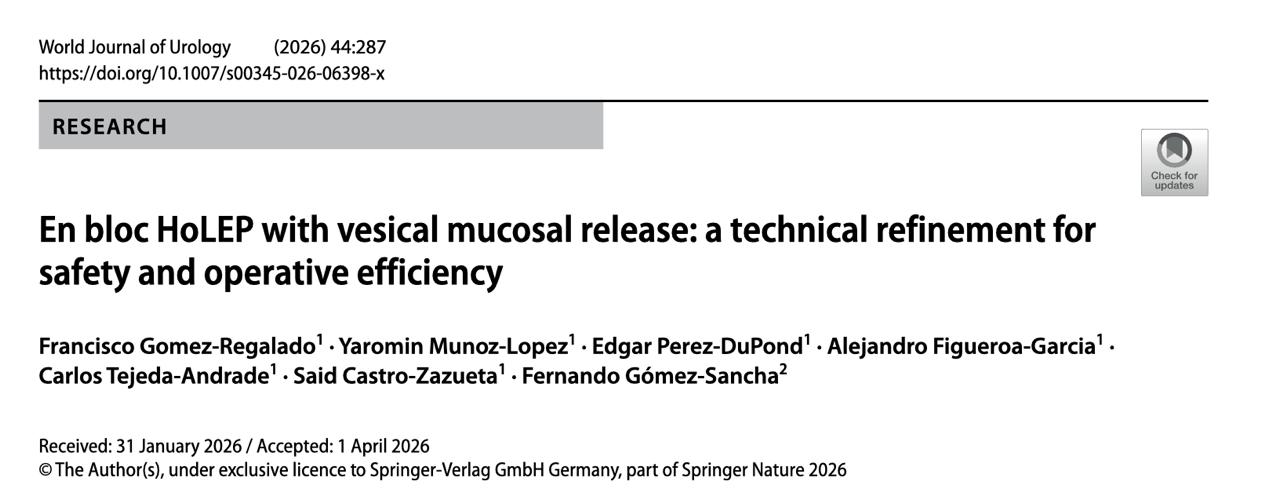
En Bloc HoLEP with Vesical Mucosal Release: A Technical Refinement for Safety


En bloc HoLEP with vesical mucosal release - World Journal of Urology 2026

Just published in World Journal of Urology: a paper that is particularly close to me. Dr. Francisco Gomez-Regalado, urologist at Hospital Angeles del Carmen in Guadalajara, Mexico, proposed an elegant idea: protect the ureteral orifices by incising the vesical mucosa before en bloc enucleation.

I liked it from the start. During en bloc HoLEP, especially in large prostates, the bladder neck dissection can get dangerously close to the ureteral orifices. The vesical mucosal release creates a safety margin that allows more confident enucleation without risking ureteral injury.

What does the study show?

A retrospective analysis of 194 consecutive patients operated between January 2024 and October 2025:

  • Median prostate volume: 80 mL
  • Median enucleated tissue: 37 grams
  • Median operative time: 83 minutes
  • Vesical mucosal release successful in 100% of cases
  • Overall complications: 1.5%
  • Ureteric orifice injury: 0.5% (1 patient)
  • Transient stress incontinence at 1 month: 2% — at 3 months: 0%

Why does this matter?

The best surgical innovations come from daily operating room experience, not from a lab. A surgeon who operates every day identifies a risk, designs a solution, and tests it. That is exactly what Dr. Gomez-Regalado did.

The most telling finding: laser power (50W vs 100W) was not independently associated with enucleation time. What matters is the technique, not the laser power.

A simple step that adds safety

This refinement adds seconds to the procedure and potentially prevents a serious complication. It is the kind of incremental innovation that advances surgical technique: practical, reproducible, and evidence-based.

Proud to be part of this work with the team from Guadalajara.

Reference: Gomez-Regalado F, Munoz-Lopez Y, Perez-DuPond E, Figueroa-Garcia A, Tejeda-Andrade C, Castro-Zazueta S, Gómez-Sancha F. En bloc HoLEP with vesical mucosal release: a technical refinement for safety and operative efficiency. World J Urol. 2026;44(1):287. PubMed | DOI

www.drgomezsancha.com

Friday, March 27, 2026

The 2026 SIU-ICUD Consultation on Male LUTS: A Structural Conflict of Interest Analysis


In March 2026, the Société Internationale d'Urologie published the SIU-ICUD Consultation on Individualized Management of Male LUTS, edited by Dean Elterman, Stavros Gravas, and Andrea Tubaro [1]. At 420 pages, with seven committees and contributors from across the world, it is a serious and comprehensive document that will serve as a reference for urologists worldwide. I read it carefully, and I believe it deserves an equally careful critical reading.

Full disclosure: I have performed over 10,000 holmium laser enucleations of the prostate (HoLEP). I have trained more than 600 urologists in this technique across 60 countries, and that training generates direct professional income. I published the technique of en-bloc HoLEP with early apical release in 2019 [9], subsequently studied in a global multicenter registry of 6,193 patients [2]. I have received speaking fees and proctoring arrangements from Quanta System, Richard Wolf, and Andromeda Surgical — manufacturers of HoLEP equipment. I receive no payment from any manufacturer of devices discussed in this article, but I have a direct professional and commercial interest in the wider adoption of HoLEP. Any reader should weigh my perspective with this in mind.

I am not a neutral observer. Neither, as I will argue with specific evidence, is this document.

I. The Declared Sponsors and the Conflict Architecture

The document's copyright page states: "The SIU-ICUD Committee would like to acknowledge the support of the following partners: Boston Scientific, GSK, Laborie, Pierre Fabre Laboratoires, PROCEPT BioRobotics, and Teleflex." [1, p. 2]

The alignment between each sponsor and its covered technology is exact:

  • Boston ScientificRezūm water vapor thermal therapy (dedicated chapter, procedural video)
  • Teleflex (NeoTract) → UroLift prostatic urethral lift (dedicated chapter)
  • PROCEPT BioRoboticsAquablation / HYDROS system (dedicated chapter, 4 corporate images, procedural video)
  • GSK → Dutasteride (Avodart/Duodart), covered in the pharmacological management chapter

Every sponsor's product appears in the clinical recommendations. This alignment is not a coincidence to be acknowledged and set aside — it is the structural condition under which the document was produced.

What follows is more specific than a general concern about industry funding.

II. The Named Positions: A Structural Analysis

The 2026 SIU-ICUD Consultation does not include a declarations-of-interest section for any committee member. In a 420-page document published in 2026, this absence stands in contrast to the declared standards of the EAU Guidelines, whose published COI policy requires individual financial disclosures and restricts panel members from voting on recommendations for technologies in which they hold significant interests [10]. Whether or not the SIU is formally bound by EAU policy — it is not — the comparison illustrates a transparency gap that clinicians using this document as a reference should be aware of.

The following biographical facts are drawn from publicly verifiable sources — the document itself, PubMed author records, and published trial registries:

Peter Gilling serves as Co-Chair of Committee 4 (Invasive Surgical Treatments), which is responsible for the Aquablation chapter [1, p. 152]. He is also the first or senior author of the WATER randomised controlled trial and the WATER II single-arm study — the two pivotal trials that establish the evidence base for Aquablation and that are cited six times in the Aquablation chapter [3,4]. Both trials were conducted with device support from PROCEPT BioRobotics, as declared in their published disclosures.

To be clear about what this means structurally: the investigator who led the manufacturer-supported trials that validated Aquablation co-directed the committee that evaluated those trials and produced the recommendation for Aquablation, in a document whose production was financially supported by that manufacturer. This arrangement raises legitimate questions about the management of conflicts of interest, regardless of the scientific integrity of any individual involved. Gilling is also one of the world's foremost experts on HoLEP — a genuine authority on both technologies — which is precisely what makes the structural arrangement worth examining rather than dismissing.

Dean Elterman is the Editor of the entire consultation [1, cover page]. He is also first author of "Focal bladder neck cautery associated with low rate of post-Aquablation bleeding" (Elterman DS et al., Can J Urol, 2021), cited as Reference 9 in the Aquablation chapter [1, p. 212]. That paper is cited in the specific passage addressing the most significant safety signal in the Aquablation evidence base: the 9.9% pre-discharge bleeding rate and 5.9% transfusion rate documented in WATER II [4]. A publication authored by the document's editor addresses a complication of the sponsor's technology, within a chapter that the same editor oversaw. Readers should be aware of this layering when evaluating how the WATER II safety data is contextualised.

Elterman's consultancy and investigator relationship with PROCEPT BioRobotics is not a matter of inference — it is declared explicitly in his published papers, including the REAP global multicenter registry (World J Urol, 2023), where his disclosures read: "Dean Elterman is a consultant/investigator for… Procept BioRobotics…" [2]. This makes the absence of any equivalent declaration in the SIU-ICUD Consultation — a document he edited — the more conspicuous.

Kevin Zorn serves as Co-Chair of Committee 5 (BPH Minimally Invasive Treatments) [1, p. 348], which covers Rezūm, UroLift, and Optilume — three technologies whose manufacturers are declared sponsors. His authorship on the Aquablation same-day discharge paper cited as Reference 5 in the Aquablation chapter, and his co-authorship on multiple papers on Rezūm cited in that chapter, are verifiable through PubMed author records.

These positional overlaps — between editorial authority and prior commercial research relationships — are presented here as structural observations, not as accusations of misconduct toward any individual.

III. The Quantitative Asymmetry

The AEEP/HoLEP chapter and the Aquablation chapter cover surgical procedures for the same clinical indication. Some editorial asymmetry is expected: Aquablation is a newer technology with more technical complexity to describe. But the nature — not only the magnitude — of the difference is worth examining:

AEEP/HoLEP Aquablation
Approximate word count ~1,875 ~2,747
References 15 21
Sponsor-funded trial references 0 6 (WATER family)
Industry-supplied images 0 4 ("courtesy of PROCEPT BioRobotics")
Trademarked product names in text 0 2 (Aquabeam®, FirstAssist AI™)
Procedural video (SIU Academy) None Yes — Aquablation®
Level of Evidence I (Ho:YAG) II
Grade of Recommendation A B

The additional length in the Aquablation chapter is not composed of clinical evidence — it is composed in part of corporate image descriptions and promotional language. No other surgical technique in Committee 4 uses images from a device manufacturer. No other chapter reproduces trademarked marketing terminology in a figure caption.

IV. Corporate Images as Scientific Figures

Four figures in the Aquablation chapter carry the credit line "Image courtesy of PROCEPT BioRobotics Corporation." [1, pp. 191–194] One presents PROCEPT's HYDROS system with a caption describing it as featuring "AI-powered treatment planning with FirstAssist AI™, advanced image guidance, and a more streamlined workflow." [1, p. 192]

The term FirstAssist AI™ — with trademark symbol — appears verbatim in a clinical consultation published under the SIU imprimatur. The EAU Guidelines do not include manufacturer-supplied promotional images. The AUA Guidelines do not. This document does, for exactly one technology, whose manufacturer is a declared sponsor.

V. Opening Paragraphs as Evidence of Register

The Aquablation chapter opens [1, p. 191]:

"Aquablation has become an integral treatment option for surgeons to effectively manage BPH while minimizing possible side effects. Not only has the literature proved the success of Aquablation, but Aquablation has also been endorsed by all major society guidelines."

The AEEP chapter opens [1, p. 178]:

"Anatomical endoscopic enucleation of the prostate (AEEP) is a highly effective surgical technique used to treat BPH… These advancements have significantly improved patient outcomes, particularly for men with large prostate glands, by reducing morbidity, improving efficacy, and minimizing complications."

The second is technical and contextual. The first is a positioning statement structured around endorsement and market adoption. The Aquablation chapter closes [1, p. 196] describing "profound long-term outcomes" — the word profound does not appear in the conclusions of any other chapter in the surgical treatment section.

VI. Procedural Videos: The Most Objective Asymmetry

The document's preface highlights its procedural videos as an innovation [1, p. VI]. The procedures with SIU Academy® videos are: Aquablation® (PROCEPT BioRobotics — sponsor), Rezūm™ (Boston Scientific — sponsor), and Optilume® [1, pp. 197, 270].

HoLEP — the procedure with Level I, Grade A evidence, the highest recommendation in the surgical section — has no procedural video. It is possible that logistical or licensing factors explain this absence; I have no access to the document's internal editorial communications. But the outcome is that the educational resource most effective for driving surgical adoption — video training — is provided exclusively for the procedures of declared sponsors, and not for the procedure with the strongest evidence base.

VII. The Volume Restriction: An Evidence Gap That Requires Explanation

The document's recommendation table stratifies by prostate volume as follows [1, pp. 168, 183, 196]:

Procedure Recommended volume LoE GoR
TURP 30–80 mL I A
Aquablation 30–80 mL II B
AEEP/HoLEP > 80 mL only I A

HoLEP is the only major endoscopic procedure in this table restricted to the large-prostate segment. This restriction is not explained in the chapter, and it is not consistent with the available evidence. Multiple Level I randomised controlled trials and meta-analyses include prostates well below 80 mL and demonstrate equivalent or superior outcomes for HoLEP versus TURP across the full volume range [5,6,7,8,9]. The 2024 EAU Guidelines on Non-neurogenic Male LUTS do not impose a lower volume threshold for endoscopic enucleation [10].

A case can be made for clinical caution: HoLEP's learning curve (~50 cases) is real, and in smaller prostates where TURP is technically straightforward, some clinicians consider enucleation less necessary. This is a legitimate clinical discussion. What is absent from the document is any explanation of why this restriction was applied to HoLEP but not to TURP — which also has a learning curve and a complication profile in smaller prostates. The absence of justification is what makes the restriction notable, not the restriction itself.

The practical consequence is significant. Prostates between 30 mL and 80 mL represent the majority of the BPH surgical population. The recommendation as written places HoLEP outside the volume range where Aquablation — a sponsor's technology with lower evidence grade — is recommended. An evidence-based justification for this asymmetry should have been provided.

VIII. The Neutralisation of the Bhatia Meta-Analysis

The document cites Bhatia et al. (2024), a network meta-analysis comparing Aquablation and HoLEP [11]. The document summarises its findings as follows [1, p. 195]:

"At 12 months, the HoLEP procedure was associated with better outcomes in terms of IPSS, QoL, PVR, and Qmax improvements, though it was associated with higher rates of incontinence. There was a higher risk of hemoglobin loss and risk of blood transfusion with Aquablation as well as higher rates of retreatment."

This is the document's own summary: HoLEP is superior in four primary functional outcomes; Aquablation has more bleeding complications and higher retreatment. The sentence that immediately follows [1, p. 195]:

"Despite the difference in functional outcomes, Aquablation operative time and hospital stays were significantly lower, presenting a compelling alternative in the outpatient setting."

The word despite performs significant editorial work here. It subordinates superiority across four functional measures to an operational scheduling consideration. This framing — where logistical advantage is positioned to offset clinical inferiority — merits scrutiny given the document's sponsorship structure. A methodological caveat is warranted: the Bhatia NMA covers 12-month outcomes, which is sufficient for functional comparison but does not capture the long-term durability advantage of HoLEP that emerges in studies with 7–10 year follow-up [4,5]. Even with that caveat, the document's characterisation of the evidence does not reflect the hierarchy of outcomes that patients typically prioritise.

IX. Technical Attribution: An Observation on Academic Practice

The document credits Peter Gilling and Fraundorfer as the developers of HoLEP using the Ho:YAG laser [1, p. 179]. This is historically accurate. The document then describes the en-bloc enucleation technique as follows [1, p. 221]:

"The en bloc technique for AEEP, which involves enucleating the entire transition zone adenoma as one tissue block, is increasingly being utilized for AEEP due to its improved enucleation efficiency and some reports of better early continence."

"Increasingly being utilized" and "some reports" are language choices that suggest an emerging, informally validated trend. In the same document, Gilling receives specific nominal credit as HoLEP's originator and six citations for the WATER trials. The contrast in attribution practices — named credit for the originating technique, anonymous treatment for a major technical evolution — is a pattern worth noting as a matter of academic convention, independent of any other argument in this article.

X. What the Document Contains That Is Valuable

The evidence grades in this document are real and correctly applied. The Level I, Grade A recommendation for HoLEP is present. The retreatment data for UroLift — 8–15% at five years [12] — is in the UroLift chapter. The superior functional outcomes for HoLEP in the Bhatia meta-analysis are cited. The WATER II bleeding data is present. The document does not fabricate evidence.

What it does is construct an editorial architecture around evidence that exists — through opening language, image selection, video provision, volume-restricted recommendations, and sentence-level framing choices — that consistently favours the technologies of its declared sponsors over the procedure with the highest level of evidence. This is how industry influence on clinical documents typically operates at present. The mechanism is present in the structure regardless of the intentions of any individual contributor.

The word unrestricted in the sponsor acknowledgment [1, p. VI] is doing significant work. The sponsors are named. Their products are covered. Their images are reproduced. Their videos are distributed under the SIU Academy label. Their funded-trial investigators co-chair the committees that evaluated their products. Individual authors do not declare conflicts of interest. These facts coexist in the same document.

XI. Recommendations for Clinicians and Health Systems

Use this document. It is comprehensive and largely accurate within the limits described above. Apply the following questions:

On evidence grades: HoLEP is Grade A, Aquablation is Grade B. This hierarchy is correctly stated. It should inform procurement and training decisions.

On the volume restriction for HoLEP: The >80 mL restriction is not supported by a body of evidence that excludes smaller prostates. Clinicians and health systems should consult the 2024 EAU Guidelines [10], which do not impose this restriction, before using this document's recommendation to exclude HoLEP from their treatment pathway for moderate-volume BPH.

On retreatment rates: Assemble and compare them independently. Published data, with appropriate caveats for different follow-up durations and study populations: HoLEP 0–1.4% at 7–10 years [4,5]; TURP 14.7% at 8 years [1, p. 168]; Rezūm 4–5% at 5 years [13]; UroLift 8–15% at 5 years [12]. These figures should be in any informed consent discussion.

On conflict-of-interest transparency: The 2024 EAU Guidelines [10] and the 2023 AUA/SUFU BPH Guideline [14] both publish individual COI declarations with specific financial disclosures. Cross-referencing this document's committee members against those declarations provides additional context.

XII. A Note on Formal Response

If the concerns raised in this article are shared by other clinicians and educators in this field, the most effective formal response would address three specific, documentable issues: (1) the absence of individual COI declarations, benchmarked against EAU and AUA policy; (2) the structural position of committee chairs with disclosed relationships to the technologies their committees evaluated; and (3) the absence of evidentiary justification for the >80 mL volume restriction on HoLEP recommendations, given the available Level I evidence across the full prostate volume range.

These are arguments that can be made on the basis of published evidence and documented policy comparisons, without requiring access to the document's internal editorial communications.

References

  1. Elterman D, Gravas S, Tubaro A (Eds). SIU-ICUD Consultation: Individualized Management of Male LUTS. Société Internationale d'Urologie. March 2026. ISBN 978-1-0688136-1-0.
  2. Gauhar V, Gómez Sancha F, Enikeev D, et al. Results from a global multicenter registry of 6193 patients to refine endoscopic anatomical enucleation of the prostate (REAP). World J Urol. 2023;41(11):3033–3040. doi:10.1007/s00345-023-04626-2
  3. Gilling P, Barber N, Bidair M, et al. WATER: A double-blind, randomized, controlled trial of Aquablation® vs transurethral resection of the prostate in benign prostatic hyperplasia. J Urol. 2019;201(5):965–973. doi:10.1097/JU.0000000000000076
  4. Desai M, Bidair M, Bhojani N, et al. WATER II (80–150 mL) procedural outcomes. BJU Int. 2019;123(1):106–112. doi:10.1111/bju.14360
  5. Elmansy HM, Kotb A, Elhilali MM. Holmium laser enucleation of the prostate: long-term durability of clinical outcomes and complication rates during 10 years of followup. J Urol. 2011;186(5):1972–1976. doi:10.1016/j.juro.2011.07.015
  6. Placer J, Gelabert-Mas A, Vallmanya F, et al. Holmium laser enucleation of prostate: outcome and complications of self-taught learning curve. Urology. 2009;73(5):1042–1048. doi:10.1016/j.urology.2008.10.074
  7. Tan AHH, Gilling PJ, Kennett KM, et al. A randomized trial comparing holmium laser enucleation of the prostate with transurethral resection of the prostate for the treatment of bladder outlet obstruction. J Urol. 2003;170(4 Pt 1):1270–1274. doi:10.1097/01.ju.0000085341.13190.5e
  8. Ahyai SA, Gilling P, Kaplan SA, et al. Meta-analysis of functional outcomes and complications following transurethral procedures for lower urinary tract symptoms resulting from benign prostatic enlargement. Eur Urol. 2010;58(3):384–397. doi:10.1016/j.eururo.2010.06.005
  9. Saitta G, Becerra JEA, Del Álamo JF, et al. En bloc HoLEP with early apical release in men with benign prostatic hyperplasia. World J Urol. 2019;37(11):2451–2458. doi:10.1007/s00345-019-02671-4
  10. Gravas S, Gacci M, Gratzke C, et al. EAU Guidelines on Non-neurogenic Male Lower Urinary Tract Symptoms. European Association of Urology. 2024 Edition. uroweb.org/guidelines
  11. Bhatia A, Titus R, Porto JG, et al. Comparing outcomes of Aquablation versus holmium laser enucleation of prostate in the treatment of benign prostatic hyperplasia: a network meta-analysis. BJUI Compass. 2024;5(12):1231–1245. doi:10.1002/bco2.454
  12. Roehrborn CG, Barkin J, Gange SN, et al. Five year results of the prospective randomized controlled prostatic urethral L.I.F.T. study. Can J Urol. 2017;24(3):8802–8813. PMID:28646935
  13. McVary KT, Rogers T, Roehrborn CG. Rezūm water vapor thermal therapy for lower urinary tract symptoms associated with benign prostatic hyperplasia: 4-year results from randomized controlled study. Urology. 2019;126:171–179. doi:10.1016/j.urology.2018.12.031
  14. Sandhu JS, Bixler BR, Dahm P, et al. Surgical Management of Lower Urinary Tract Symptoms Attributed to Benign Prostatic Hyperplasia: AUA Guideline (2023 Update). J Urol. 2023;210(1):11–19. doi:10.1097/JU.0000000000003698

Dr. Fernando Gómez Sancha is Medical Director of ICUA (Instituto de Cirugía Urológica Avanzada) at Clínica CEMTRO, Madrid. He has performed over 10,000 HoLEP procedures and trained urologists across 60 countries, generating direct professional income from that training. He discloses speaking and proctoring arrangements with Quanta System, Richard Wolf, and Andromeda Surgical — manufacturers of HoLEP equipment. He receives no payment from any manufacturer of devices discussed in this article. The author's direct interest in the broader adoption of HoLEP should be considered when evaluating the arguments presented here.

@fgomsan · ICUA.es · LinkedIn

llms.txt