
Last updated: March 2026
The prostate grows with age. It is as inevitable as grey hair. From the age of 30, prostatic tissue begins to develop what we call benign prostatic hyperplasia (BPH) — a growth that, in many men, will eventually cause bothersome symptoms or complications that seriously affect quality of life.
If you are reading this article, you have probably been diagnosed with a prostate problem and are looking for information about your surgical options. I will explain clearly what HoLEP is, why I consider it the best available surgical treatment for BPH, and what we have contributed at ICUA to refine this technique over more than 20 years.
When does the prostate become a problem?
Symptoms appear when prostatic growth compresses the urethra and makes it difficult for urine to flow. The patient notices a weak stream, difficulty starting urination, a feeling of incomplete bladder emptying, and waking up several times at night. In more advanced cases, serious complications arise: acute urinary retention (complete inability to urinate, requiring a catheter), recurrent urinary infections, prostatic bleeding, bladder stones, and even kidney damage.
I often tell my patients that there are two types of cases: those with a mandatory indication for surgery — retention, stones, kidney failure, bleeding, recurrent infections — and those who are not obliged to undergo surgery but meet the criteria for us to recommend it. In both scenarios, it is important to understand that BPH is a progressive disease. The bladder deteriorates if the obstruction is not adequately treated, and there is a window of opportunity to act before bladder damage becomes irreversible.
What is HoLEP?
HoLEP stands for Holmium Laser Enucleation of the Prostate. It is a surgical technique that uses a high-precision laser to separate the prostatic adenoma (the tissue that has grown and causes obstruction) from the prostatic capsule, and remove it completely.
The technique was originally developed in New Zealand in the 1990s by Drs Gilling and Fraundorfer. Since then, it has undergone enormous evolution, with multiple technical refinements that have improved outcomes and made it easier to learn. The clinical guidelines of both the European Association of Urology (EAU) and the American Urological Association (AUA) recommend it as a standard option, regardless of prostate size.
How is HoLEP different from other techniques?
There are many options for prostate surgery, and it is perfectly normal for patients to feel confused. The fundamental difference lies in the concept: enucleation is not the same as resection or vaporisation.
Transurethral resection (TURP) is the classic technique. An electrical loop cuts the adenoma into small chips, like carving a statue from the inside. The problem is that it never removes all the tissue — remnants are always left behind that can regrow. And in large prostates, the procedure becomes very lengthy, increasing the risk of bleeding and other complications. The long-term retreatment rate with TURP ranges from 10 to 15%.
GreenLight laser vaporisation destroys prostatic tissue by evaporating it. It is very safe in terms of bleeding, but has a limitation: the tissue disappears, leaving no specimen for laboratory analysis, and in large prostates the procedure is very slow and often incomplete.
Enucleation (HoLEP) follows the natural anatomical plane between the adenoma and the capsule, separating them completely. It uses the same principle as classic open surgery — which for decades was the gold standard for large prostates — but without incisions, without transfusions, and with a much faster recovery. And crucially: the entire adenoma is removed, so the retreatment rate is below 2%.
The conceptual difference is this: TURP and vaporisation work from the urethra outward, carving a channel through the adenoma. HoLEP works from the outside in, peeling the entire adenoma off the capsule. It is an anatomical, complete, and definitive operation.
What is en bloc enucleation?
The original HoLEP technique separated the adenoma into two or three lobes that were pushed into the bladder separately. It was effective, but technically demanding with a long learning curve.
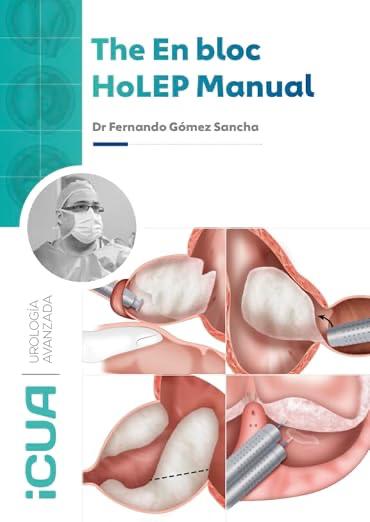
Over the course of my experience, first with the GreenLight laser and subsequently with the holmium laser, I developed a technique we call en bloc enucleation with early apical release and sphincteric mucosal preservation. Instead of dividing the adenoma into fragments, we separate it from the capsule in a single piece — en bloc, like peeling an entire orange.
The procedure begins by marking the boundary between the apex of the adenoma and the external urinary sphincter — what we call the "white line." From there, we release the sphincter from the adenoma early, protecting it from the very first moment of the surgery. We then dissect the adenoma circumferentially until the entire piece can be pushed into the bladder, where it is fragmented with an instrument called a morcellator for extraction.
This technique has several proven advantages:
It is faster. A randomised controlled trial published in 2025 directly compared en bloc enucleation with the conventional lobe-by-lobe technique. The en bloc approach reduced enucleation time from 74 to 62 minutes and total operative time from 95 to 79 minutes, with lower laser energy consumption. A prospective study of 600 patients also confirmed that the three-lobe technique is significantly slower than en bloc.
It better preserves continence. Early release of the sphincter minimises traction throughout the surgery. In our series of 754 consecutive patients operated with this technique, published in World Journal of Urology in 2025, the stress incontinence rate at 6 months was 0.15% for prostates under 120 grams and 0.9% for those above. These are extraordinarily low figures.
It is easier to learn. A study published in Translational Andrology and Urology showed that with the en bloc technique, a beginner surgeon reaches a reasonable level of competence in 20–30 cases, compared to 50 needed with the classic three-lobe technique. A study from the University of Mannheim with 500 consecutive en bloc cases confirmed continuous improvement in efficiency even after hundreds of procedures.
It works equally well for prostates of any size. In fact, the larger the prostate, the more efficient en bloc enucleation becomes. In our published series, enucleation efficiency in large prostates was 3.1 grams per minute — double that of smaller prostates. We have operated on prostates weighing 300, 400, and even 500 grams with this technique, with excellent results.
Who is HoLEP suitable for?
One of HoLEP's great advantages is that it has no prostate size limit. While TURP has a practical ceiling around 80 grams and other treatments such as Aquablation have a limited range, HoLEP can treat prostates of any volume. It is the only endoscopic technique that truly replaces open surgery, with the same efficacy but without its drawbacks.
It is especially indicated for:
- Large prostates (over 80–100 grams), where other endoscopic techniques fall short.
- Patients on anticoagulants, thanks to the excellent haemostatic properties of the holmium laser. The transfusion rate in our series is below 1%.
- Patients with indwelling catheters, who need a definitive solution to their obstruction.
- Patients with bladder stones, which can be treated in the same session with the same laser.
- Any patient seeking a definitive solution with the lowest possible retreatment rate.
The importance of surgeon experience
I must be honest about one thing: HoLEP is a technique that depends heavily on the skill and experience of the surgeon. Having the laser is not enough — you need to know how to use it. The learning curve exists, although modern techniques such as en bloc enucleation have shortened it significantly.
How can you tell whether your surgeon has the necessary experience? There are a few reasonable questions you can ask: how many enucleations have they performed, whether they have published their own results, whether they train other surgeons in the technique. A surgeon who teaches others has, by definition, a deep mastery of what they do.
At ICUA, we have been performing laser prostatectomies since 2003 and enucleations since 2007. We have accumulated over 10,000 prostatic enucleations. I described the GreenLight en bloc enucleation technique (GreenLEP) published in World Journal of Urology in 2015, and the en bloc HoLEP technique with early apical release published in 2019. Our series of 754 consecutive cases using this technique was published in 2025. We are co-authors on the REAP registry, the largest global multicentre database for prostatic enucleation, comprising 6,193 patients from 10 centres in 7 countries. We have trained surgeons from over 60 countries in our operating theatres in Madrid and Sofia.
What can you expect after HoLEP?
Most patients are admitted in the morning, undergo the procedure under spinal anaesthesia (numb from the waist down), and can go home the following day, without a catheter in most cases. Urinary flow improves immediately and dramatically — in our series, peak flow rate goes from 8 ml/s before surgery to 24–28 ml/s afterwards.
Recovery is swift: normal daily activities within 2–3 days, although some urinary symptoms such as urgency or mild burning may persist for a few weeks. These are transient and resolve progressively.
After HoLEP, PSA should drop below 1 ng/mL — an important marker for follow-up that reflects the completeness of the enucleation. In our series, the PSA reduction was 93–94%.
The vast majority of patients are able to discontinue all prostate medication and never require further surgery.
Request a consultation at ICUA · Clínica CEMTRO, Madrid — or a video consultation if you are outside Spain.
📞 +34 91 435 28 44 · ✉ icua@icua.es
Because as I tell my patients: you don't have to be the first to have surgery, but you shouldn't be the last either.
Scientific references
- Saitta G, Becerra JEA, Del Álamo JF, et al. 'En Bloc' HoLEP with early apical release in men with benign prostatic hyperplasia. World J Urol. 2019;37:2451-2458. PubMed
- Iscaife A, Rodríguez Socarrás M, Talizin TB, et al. Contemporary results of En Bloc HoLEP for large prostates. World J Urol. 2025;43:401. PubMed
- Gomez Sancha F, Rivera VC, Georgiev G, et al. Common trend: move to enucleation — Is there a case for GreenLight enucleation? Development and description of the technique. World J Urol. 2015;33:539-547. DOI (Open Access)
- Gauhar V, Gómez Sancha F, Enikeev D, et al. Results from a global multicenter registry of 6193 patients to refine endoscopic anatomical enucleation of the prostate (REAP). World J Urol. 2023;41:3033-3040. PubMed
- Gauhar V, Lim EJ, Fong KY, et al. Influence of early apical release on outcomes in endoscopic enucleation of the prostate: results from a multicenter series of 4392 patients. Urology. 2024;187:154-161. DOI
- Rücker F, Lehrich K, Böhme A, et al. A call for HoLEP: en-bloc vs. two-lobe vs. three-lobe. World J Urol. 2021;39:2337-2345. DOI
- Wenk MJ, Hartung FO, Egen L, et al. The long-term learning curve of HoLEP in the en-bloc technique: a single surgeon series of 500 consecutive cases. World J Urol. 2024;42:436. PubMed
- Li P, Wang C, Tang M, et al. The en bloc method is feasible for beginners learning to perform HoLEP. Transl Androl Urol. 2023;12(3):379-390. PubMed Central


No comments:
Post a Comment