
Last updated: March 2026
If you have been told that your prostate is very large — 100, 150, 200 grams or more — and that you need surgery, you have probably been offered two options: open surgery (an abdominal incision) or living with a catheter. There is a third option that you may not have been offered, because not all centres can perform it: en bloc holmium laser enucleation of the prostate (HoLEP).
And it does not just work for large prostates — it is where it works best.
What is considered a large prostate?
Prostate size is usually measured in grams or millilitres (they are essentially equivalent). A useful classification:
- Small: under 30 grams — rarely requires surgery.
- Medium: 30–80 grams — most techniques work well.
- Large: 80–150 grams — this is where many techniques start to struggle.
- Very large: over 150 grams — territory where few techniques are viable.
Size matters because it determines which surgical techniques can be used safely and effectively. And it is precisely with large and very large prostates that the differences between techniques become most apparent.
The problem with large prostates and conventional techniques
TURP (transurethral resection)
TURP has a practical ceiling around 80 grams. Attempting to resect a 150-gram prostate with an electrical loop is like trying to empty a well with a bucket: it takes too long, there is too much bleeding, and you never manage to remove all the tissue. The risk of fluid absorption syndrome (TUR syndrome) increases with operating time. This is why the clinical guidelines do not recommend TURP for large prostates.
GreenLight laser
GreenLight vaporisation works well for medium-sized prostates, but for large ones it faces the same problem: vaporising 100 or 150 grams of tissue takes an excessive amount of time, and it is very difficult to ensure all the adenoma has been removed. The retreatment rate for large prostates treated with GreenLight can reach 9%.
Aquablation
Aquablation is approved for prostates between 30 and 150 ml. It has an upper size limit, and data in large prostates show significantly higher rates of postoperative bleeding. It is not an enucleative technique — it destroys part of the adenoma but does not remove it completely.
Open surgery
Open simple prostatectomy is effective for prostates of any size — the surgeon opens the abdomen and removes the adenoma with their fingers. It works, but at considerable cost to the patient: abdominal incision, significant bleeding, 5–7 day hospital stay, prolonged catheterisation, and 4–6 weeks' recovery. For over a century it was the only option for large prostates. It no longer needs to be.
Why en bloc HoLEP has no size limit
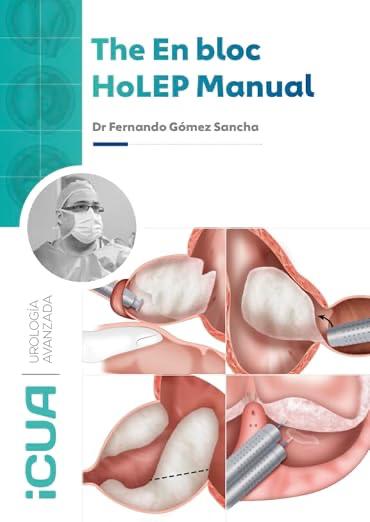
HoLEP follows the natural anatomical plane between the adenoma and the prostatic capsule — the very same plane that the surgeon's finger follows in open surgery. But it does so with laser precision, without incisions, and with minimal bleeding.
And here is the paradox: the larger the prostate, the more efficient en bloc enucleation becomes. Why? Because in large prostates the plane between adenoma and capsule is better defined — easier to find and follow. The adenoma is softer, more pedunculated, and peels away more readily. It is like peeling a large orange: the segments separate from the peel with less effort than in a small one.
Our published data on large prostates
In 2025, we published in World Journal of Urology the results of 754 consecutive patients operated with our en bloc technique. Of these, 110 had prostates of 120 grams or more (median 143.5 grams). We compared them with the 644 patients with smaller prostates.
| Parameter | Prostate <120 g (n=644) | Prostate ≥120 g (n=110) |
|---|---|---|
| Size (median) | 60 g | 143.5 g |
| Enucleation time | 25 min | 40 min |
| Enucleation efficiency | 1.9 g/min | 3.1 g/min |
| Tissue removed | 38.9 g | 98.7 g |
| Stress incontinence 1 month | 3.4% | 8.2% |
| Stress incontinence 3 months | 1.4% | 1.8% |
| Stress incontinence 6 months | 0.15% | 0.9% |
| Transfusion rate | 0.31% | 0.9% |
| PSA reduction | 92.9% | 94.4% |
| Qmax at 3 months | 24 ml/s | 28 ml/s |
Several findings deserve comment:
Efficiency doubles in large prostates. We enucleated at 3.1 g/min in the large group versus 1.9 g/min in the normal group. This confirms that the dissection plane is better defined in larger glands.
Continence at 6 months is excellent in both groups. At one month, the large prostate group does have slightly more transient incontinence (8.2% vs 3.4%), which is expected — more tissue has been manipulated near the sphincter. But by 3 months the figures are comparable, and by 6 months they are below 1% in both groups.
PSA reduction is 94.4% in large prostates — even higher than in the normal group. This demonstrates the completeness of the enucleation: virtually all the adenoma has been removed.
Postoperative urinary flow is actually higher in the large prostate group (28 ml/s vs 24 ml/s), because the cavity left after removing a large adenoma allows a wider urinary channel.
Beyond 150 grams: prostates of 200, 300, and even 500 grams
In our experience, we have operated on prostates of exceptional size — 300, 400, and even 500 grams — with excellent results. These are cases that historically could only be resolved with open surgery, with everything that entails for the patient.
A multicentre study published in World Journal of Urology in 2023 by Tricard and colleagues, boldly titled "Open simple prostatectomy is dead," demonstrated excellent HoLEP outcomes in prostates over 150 ml, confirming that there is no longer any justification for opening a patient's abdomen to operate on their prostate.
Specific advantages of the en bloc approach for large prostates
- Shorter morcellation time: Removing the adenoma in a single piece means subsequent fragmentation is faster and more efficient than if two or three separate lobes had been pushed into the bladder.
- Complete specimen for histopathology: All the tissue is sent to the pathologist, allowing a thorough histological assessment. This is particularly important in large prostates, where the probability of finding incidental cancer is low but not negligible.
- Better orientation during surgery: Dissecting en bloc means the surgeon always has a clear anatomical reference. In a 200-gram prostate, getting lost inside the adenoma is easy with fragmented techniques — with en bloc, you always know where you are.
"The prostate complicates old age"
This is a concept I always explain to my patients. A man who at 60–65 has a large obstructive prostate and decides not to undergo surgery runs the risk that at 75–80, when admitted for a hip fracture or knee replacement, he will develop urinary retention that dramatically complicates his life. A large prostate does not stop growing, and the bladder deteriorates with every year of untreated obstruction.
The great advantage of enucleation is that it offers a very high probability of being the only treatment the patient will ever need. We are not "fixing a tooth" that will need retreating in a few years. We are solving the problem definitively.
Send us your medical reports for a second opinion. At ICUA, we operate on prostates of any size.
📞 +34 91 435 28 44 · ✉ icua@icua.es
Scientific references
- Iscaife A, Rodríguez Socarrás M, Talizin TB, et al. Contemporary results of En Bloc HoLEP for large prostates. World J Urol. 2025;43:401. PubMed
- Tricard T, Xia S, Xiao D, et al. Outcomes of HoLEP for very large-sized BPH (over 150 mL): open simple prostatectomy is dead. World J Urol. 2023;41:2249-2253. DOI
- Saitta G, Becerra JEA, Del Álamo JF, et al. 'En Bloc' HoLEP with early apical release. World J Urol. 2019;37:2451-2458. PubMed
- Juliebø-Jones P, Gauhar V, Castellani D, et al. En-bloc vs non en-bloc for large and very large prostates: propensity score matched analysis. World J Urol. 2024;42:299. DOI
- Gauhar V, Gómez Sancha F, Enikeev D, et al. Results from a global multicenter registry of 6193 patients (REAP). World J Urol. 2023;41:3033-3040. PubMed
- Gomez Sancha F, Rivera VC, Georgiev G, et al. Common trend: move to enucleation — Is there a case for GreenLight enucleation? World J Urol. 2015;33:539-547. DOI (Open Access)


No comments:
Post a Comment