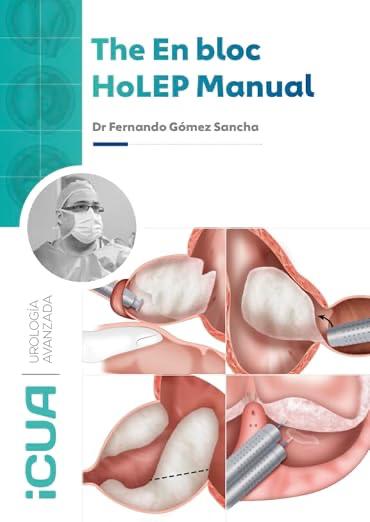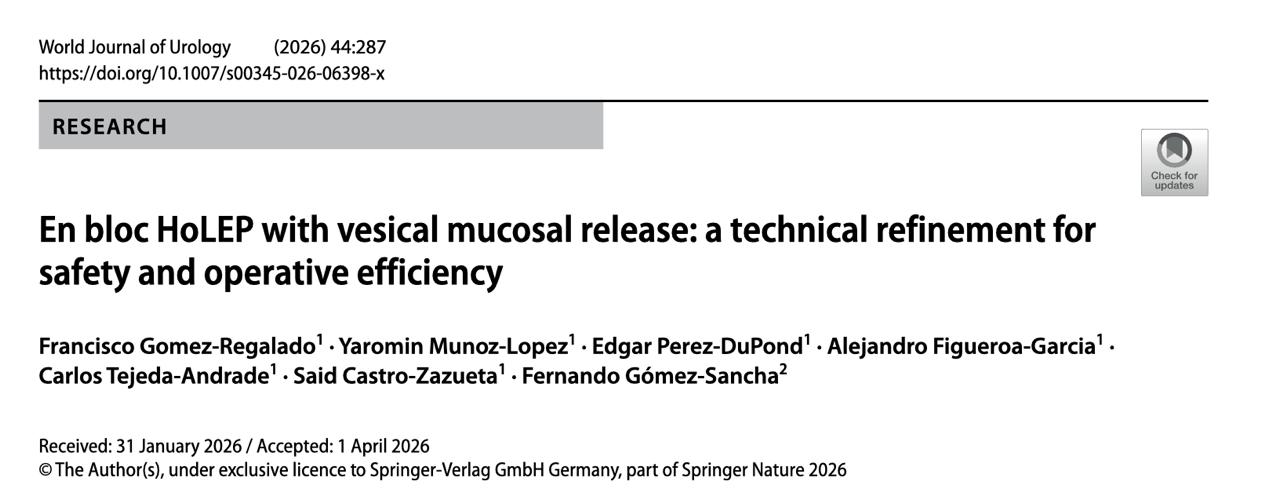
Just published in World Journal of Urology: a paper that is particularly close to me. Dr. Francisco Gomez-Regalado, urologist at Hospital Angeles del Carmen in Guadalajara, Mexico, proposed an elegant idea: protect the ureteral orifices by incising the vesical mucosa before en bloc enucleation.
I liked it from the start. During en bloc HoLEP, especially in large prostates, the bladder neck dissection can get dangerously close to the ureteral orifices. The vesical mucosal release creates a safety margin that allows more confident enucleation without risking ureteral injury.
What does the study show?
A retrospective analysis of 194 consecutive patients operated between January 2024 and October 2025:
- Median prostate volume: 80 mL
- Median enucleated tissue: 37 grams
- Median operative time: 83 minutes
- Vesical mucosal release successful in 100% of cases
- Overall complications: 1.5%
- Ureteric orifice injury: 0.5% (1 patient)
- Transient stress incontinence at 1 month: 2% — at 3 months: 0%
Why does this matter?
The best surgical innovations come from daily operating room experience, not from a lab. A surgeon who operates every day identifies a risk, designs a solution, and tests it. That is exactly what Dr. Gomez-Regalado did.
The most telling finding: laser power (50W vs 100W) was not independently associated with enucleation time. What matters is the technique, not the laser power.
A simple step that adds safety
This refinement adds seconds to the procedure and potentially prevents a serious complication. It is the kind of incremental innovation that advances surgical technique: practical, reproducible, and evidence-based.
Proud to be part of this work with the team from Guadalajara.
Reference: Gomez-Regalado F, Munoz-Lopez Y, Perez-DuPond E, Figueroa-Garcia A, Tejeda-Andrade C, Castro-Zazueta S, Gómez-Sancha F. En bloc HoLEP with vesical mucosal release: a technical refinement for safety and operative efficiency. World J Urol. 2026;44(1):287. PubMed | DOI