This year the Annual congress of the American Urological Association, that was going to take place in Washington DC has been cancelled.
Instead, all scientific works that were going to be presented there, will be published online.
This year we boosted our scientific activities, and the results are starting to be visible. We present 4 abstracts.
One comparing the En bloc endoscopic enucleation of the prostate with early apical liberation with GreenLight and Holmium lasers.
Another video-abstract on Aquablation
Another one on the results of the iTIND device for the treatment of LUTS sugestive of benign prostatic obstruction.
And finally, the work that makes me proudest, that has also been accepted for publication in the Journal of Urology, and the result of the hard work of the group, but specifically due to the stubbornness of my colleagues Dr. Moisés Rodriguez Socarrás and Dr. Juan Gómez Rivas. It is our protocol for the diagnosis of prostate cancer combining microultrasound (ExactVU system) and transperineal fusion biopsies (Biopsee system).
The coronavirus has brought us many bad things. But it has pushed us to step forward in the digital world. I think future medical congresses will no longer be as in the past. More and more, medical training and scientific exchange will take place online.
The coronavirus infection has taken us all by surprise, we could not imagine the dimension this was going to take in such a short time.
We have been forced to stop our consultations and elective surgeries to only operate on urological and oncological emergencies, to protect our patients and the staff from ICUA and Clinica CEMTRO of the danger of contagion. We have cancelled our programmed attendance to courses and congresses as well as all the training courses, internships and visitorships we had programmed.
Clínica CEMTRO has devoted all its efforts and resources to help to cope with this terrible infection and all the urology staff supports the clinic in this endeavour. Sadly, some of the members of our team are isolated at home affected by the infection.
We will still offer telephone and video-conference consultations and we remain available to our patients at www.icua.es & www.clinicacemtro.com. You can contact us at:
Telephone +34914352844
E-mail: icua@icua.es
This time we welcomed the visit of Dr. Baghaloo, from South Africa, who spent two days with us in the operating room. There is a growing interest in HoLEP in South Africa.
Again we received the visit of urologists from Epsom Hospitals near London. We shared two days of surgery and I explained the en bloc technique with early apical release and the MOSES Holmium laser.
It was a very nice session and I enjoyed the company of these colleagues. I stayed in London for one year doing a reconstructive urology fellowship, right after my specialization and I keep excellent memories from that time. Many of my colleagues from that time are now eminent urologists in the UK
This time I participated in the user meeting organized by Abex, the distributor for the Da Vinci system in Spain and Portugal, that took place at the "Casa de América" in Madrid.
My role was to speak about strategies to improve urinary continence after radical robotic prostatectomy.
I discussed the posterior reconstruction described by Rocco, the anterior and posterior reconstruction preconized by Tewari, the periurethral suspension of Patel, the ARVUS technique, the anterior reconstruction, MULP technique and bladder neck preservation.
Then I spoke about the preservation of the Retzius space, but then I centred myself in discussing the advantages of the right lateral approach of Dr Gaston, that in a certain way encompasses all these techniques by preserving the anterior support, allowing for the preservation of the bladder neck, preservation of urethral length, and has the advantage of allowing to perform an intra, inter or extrafascial dissection in each side and to decide if the neurovascular pubovesical complex of Santorini is preserved or not, depending on the location and aggressiveness of the tumour.
I also presented our results at ICUA-Clinica CEMTRO, with excellent continence preservation with this technique. Dr Reinoso Elbers and Dr Rodriguez Socarrás from our team reviewed all our robotic experience of these last years and they carried out the statistical analysis of our data.
Continence preservation is optimal when the whole periprostatic tissue can be preserved, and a little worse when we have to be more aggressive to cure the tumour. The definition of continence or incontinence we used was the need to carry a pad or not.
I also showed that this technique, although technically difficult and demanding, is perfectly reproducible, as there are no statistical differences in the results obtained by Dr Gaston and myself in terms of urinary incontinence.
We published some videos in youtube of this technique performed by Dr. Gaston and myself. I include them here.
It is a great satisfaction to see how robotic surgery is becoming solid in spain for urologic surgery. The Da Vinci robot allows us to perform surgeries in a minimally invasive way and achieve results that are not possible with conventional laparoscopy or open surgery. An excellent initiative of Abex, to get us all in one room to discuss and share our experiences.
This week we received the visit of two urologists from the Royal Free Hospital in London, who are already expert HoLEP surgeons, who were interested in learning the technique of En-bloc MoLEP (HoLEP with Moses technology) with an early apical release.
Mr Cohen and Ellis spent two days with us watching operations and we had a great time sharing tips and tricks on HoLEP, as well as discussing the subtleties of this technique that we published recently.
This time I went to Barcelona to participate in the international course UROFORUM, organized by the Clinic Hospital in Barcelona.
My role was to participate in an expert panel with Dr Javier Sánchez and Dr Cesare Scoffone on endoscopic enucleation of the prostate with Holmium laser.
I presented my technique of en bloc enucleation with an early apical release. I recently published a video on the technique in youtube, that I include here.
Sadly I could not stay for the remainder of the course as I had a lot of work in Madrid. UROFORUM is an important international meeting in Europe. From now on it will deal with oncological urology one year and alternatively non-oncological urology the following year.
This time I went to Barcelona to participate in this course organized by the European School of Urology and the European School of Uro-Technology (ESUT).
My role was to participate in a round table discussing clinical cases and then I went to the operating room at Fundació Puigvert to perform a live surgical case that was broadcasted to the main auditorium of the course.
I performed an En-bloc enucleation with early apical liberation with the Holmium laser with MOSES technology. I was a bit uncomfortable during the operation as I do not usually use the Kuntz applicator for my operations, but the case went very well. I could demonstrate an excellent preservation of the external sphincter and later I was informed that the postoperative course of the patient was excellent. We published this technique recently and I think it is going to improve the results of HoLEP procedures. There are many urologists now in Europe adopting this approach.
As always, the organization at Hospital Sant Pau and Fundació Puigvert was impeccable.
This time I was invited to the Technology and Training in Endourology meeting that took place in Torino, Italy, organized by Dr. Scoffone, from the Hospital Cottolengo in Torino.
I participated in various sessions, moderating some live cases, participating in a round table on how to manage complications of endoscopic enucleation of the prostate.
I also performed a live surgical demonstration that was broadcasted to the main auditorium, to show the new technique En bloc HoLEP with early apical release with MOSES technology, that was very welcomed. I presented a video as well of how this technique is specially useful in the redo cases, where the patient was submitted before to other endoscopic surgery.
A very well organized meeting, with all the relevant European experts surrounded by friendship and camaraderie. A great meeting!
This time the World Congress of Endourology took place in Abu Dhabi, at the United Arab Emirates.
I had a busy congress.
First I presented the results of a study carried out at Clinica CEMTRO comparing the En bloc approach with GreenLight laser and Holmium laser favoring the Holmium laser for this technique.
Then I presented a video of the En bloc MoLEP (MOSES HoLEP) with early apical release that was very well received and I had to answer a lot of questions.
Then I participated in various sessions during the congress, as a moderator or panelist. I was very busy!
It was a great congress, very interesting, with a lot of new stuff, and I was very satisfied to see how we daily work at the maximum level and in the cutting edge of our fiend in Endourology for the treatment of prostate and stone disease, as well as in robotic surgery.
In my second participation in this international channel of video-surgery, we retransmitted a live surgical operation performed at ICUA-Clínica CEMTRO in Madrid.
The transmission had a lot of impact and has been watched all over the world. Click below to see the youtube video, that seems to be getting a lot of attention as well.
I am very happy and proud of this technique, as we are observing very satisfactory results. It is quite fast and save and diminishes enormously the risk of early temporary urinary incontinence that is suffered by some patients after endoscopic enucleation of the prostate with the Holmium laser.
Almost 6000 people watched it worldwide! I would love it to inspire other urologists to learn this wonderful technique and to help many patients worldwide.
I started the "academic" year this season visiting the south of France, in the gorgeous region of Perigord. I was invited to the French HoLEP group yearly meeting.
In this occasion I spoke about the En bloc HoLEP with early apical release, that is generating a lot of attention in the world of anatomic endoscopic enucleation of the prostate.
It was a very nice meeting and it was very nice to listen to other French experts presenting their experiences and concepts. The region of Perigord is really gorgeous and it is definitely worth visiting it!
This time I was invited to perform a live surgery transmission at the IV Jornada de Cáncer Urológico that was celebrated at the NHS Hospital Complex in Jaén.
My task was to demonstrate the en-bloc enucleation with Holmium laser. The case that was selected was very difficult. This patient had a 300 cc prostate.
The enucleation phase went very well and was finished in one hour, but we experienced some difficulty during the morcellation phase, that needed one additional hour, and not the usual 30-40 minutes for such a prostate size. We obtained 270 g of tissue.
Cases like this are not so frequent, and logically they are more difficult than usual cases, due to the excessive size of the prostate gland, but luckily the case was completed successfully and some days later they told me that the patient had gone home very happy.
This time I flew to Berlin, Germany, to participate in a course on the use of Holmium laser for the treatment of urinary stones, tumors, and Benign Prostate Hyperplasia.
My role was to perform a surgical procedure in a patient with Benign Prostate Hyperplasia to demonstrate the technique of En Bloc HoLEP that we have recently described.
The operation went very well, and I could finish it in 30 minutes. I had the possibility to defend this approach in opposition to the classic technique of enucleation in three pieces of the prostatic adenoma. In my opinion, this technique has many advantages, the most significant being to reduce the risk of postoperative transient incontinence.
This time I went to Poland to participate in the Endorology Congress of the Polish Urological Society, that took place in the city of Bidgoszcz. I was invited to perform a live operation showcasing the En bloc technique for HoLEP.
The patient I operated had a 200 cc prostate and the operation went very well, causing a big impression in the urologists attending, as I could complete the operation in 75 minutes, and many urologists believe these operations take hours.
I also had the opportunity to present on this technique that same evening. I then went to Warsaw where I stayed one more day to operate with my friends at the Hospital Sant Anny in Piaseczno, before returning to Madrid.
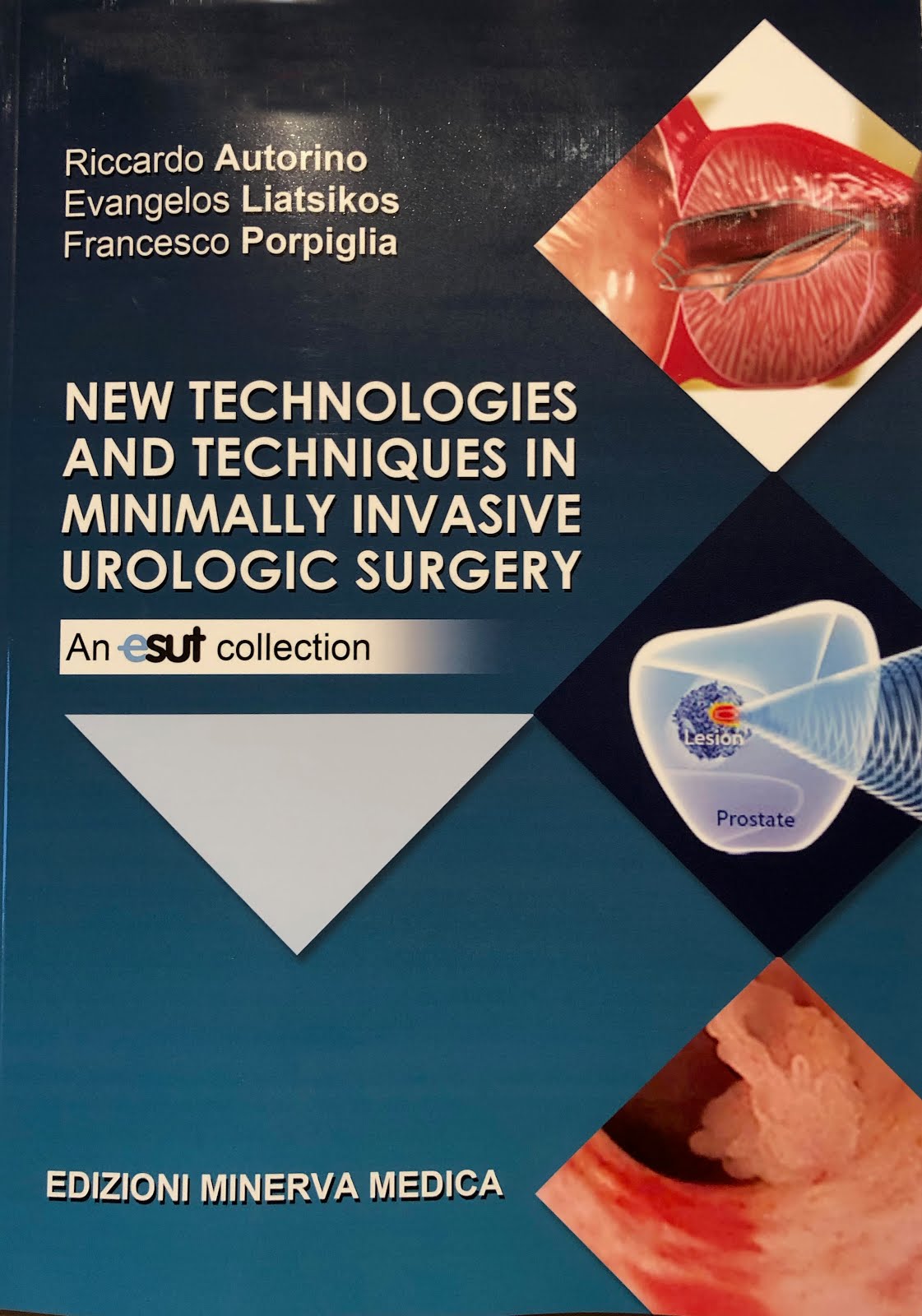
During the last congress of the European Association of Urology this book, edited by the ESUT (European Society of Uro-Technology), was launched. I contributed with a chapter on Green Laser enucleation of the prostate. It is a book written by European experts on minimally invasive surgery in urology. It can be bought through the editorial website minerva médica.
This time The Congress of the European Association of Urology took place close from home, in Barcelona. The weather was really nice with sunny days that our colleagues from northern Europe appreciated a lot.
First I participated in the joint session EAU-CAU (American Confederation of Urology), where I was invited to give a lecture on "Prostate Enucleation, Holmium or GreenLight laser". I commented on my experience with both techniques and explained my personal evolution. It started with vaporization and moved on to the description of the surgical technique for anatomic vaporization. How then I described a new technique for Green laser enucleation and finally leading to the recent publication of the en bloc enucleation with the early apical release with the holmium laser.
The following day I moderated a section of the live surgery transmissions organised by the ESUT (European Society of Uro-Technology), where several surgical techniques were presented and retransmitted live from Fundació Puigvert in Barcelona.
The auditorium was impressive, with such a big screen. It was a great pleasure to see Dr. Rijo from Barcelona present his video on my technique of Green laser endoscopic enucleation of the prostate.
The following day, in another ESUT session, I presented this technique step by step with other international experts that spoke about other endoscopic enucleation techniques.
I also did two informal presentations during the congress at the Lumenis stand in the commercial exhibition area, on the role and advantages of En-bloc enucleation and the new MOSES technology.
Finally, I moderated a session in my last congress day where videos were presented on the advances of surgical techniques for the treatment of BPH and new prostate biopsy techniques for the advanced diagnosis of prostate cancer.
In sum, a very interesting congress, full of new innovative concepts in all areas of urology.
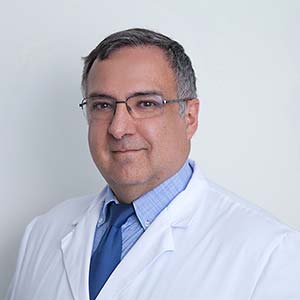
Urologist. HoLEP and robotic surgery specialist. Head of Urology at Clínica CEMTRO, Madrid. I have operated in over 50 countries and performed more than 10,000 laser procedures.